Donate to Support this Site and Research
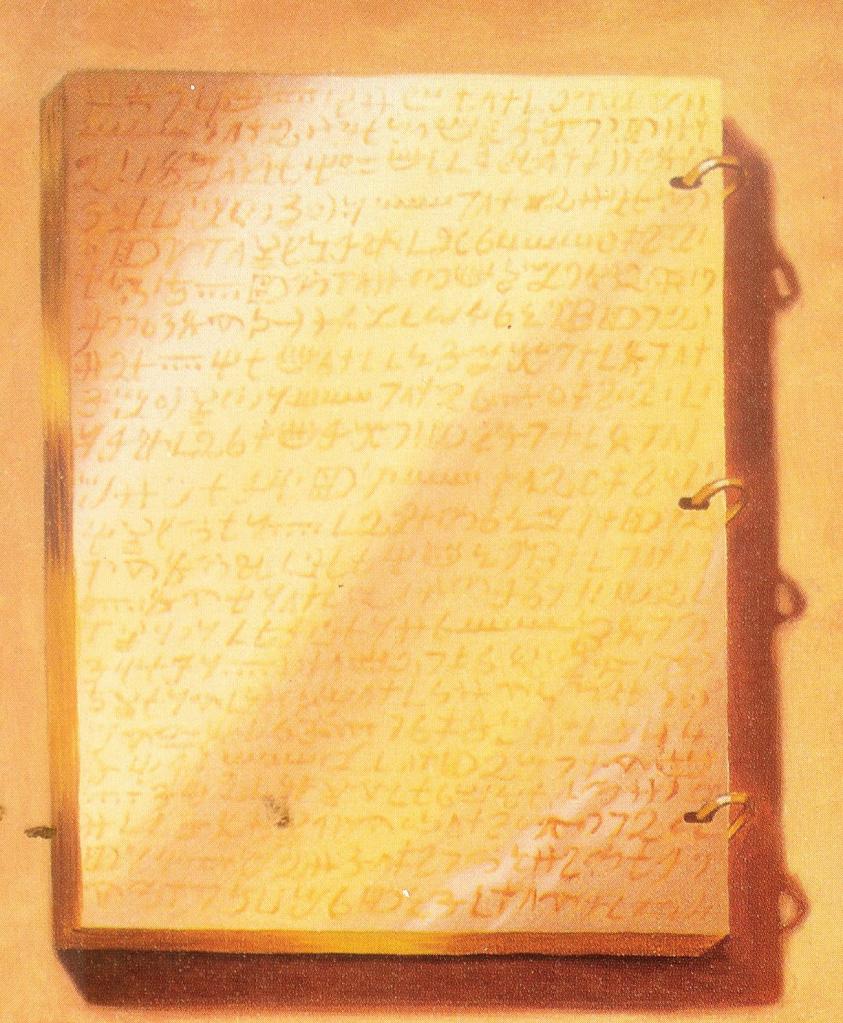
I Nefi, having been born of goodly parents, therefore I was taught somewhat in all the learning of my father. And having seen many afflictions in the course of my days, nevertheless, having been highly favored of YHWH in all my days, yes, having had a great knowledge of the goodness and the mysteries of Elohim, therefore I make a record of my proceedings in my days. Yes, I make a record in the language of my father, which consists of the learning of the Y’hudim and the language of the Egyptians. And I know that the record which I make is true; and I make it with my own hand, and I make it according to my knowledge.
(1Nephi 1:1-3 LDS; 1:1-2 RLDS; 1:1 Stick of Joseph)
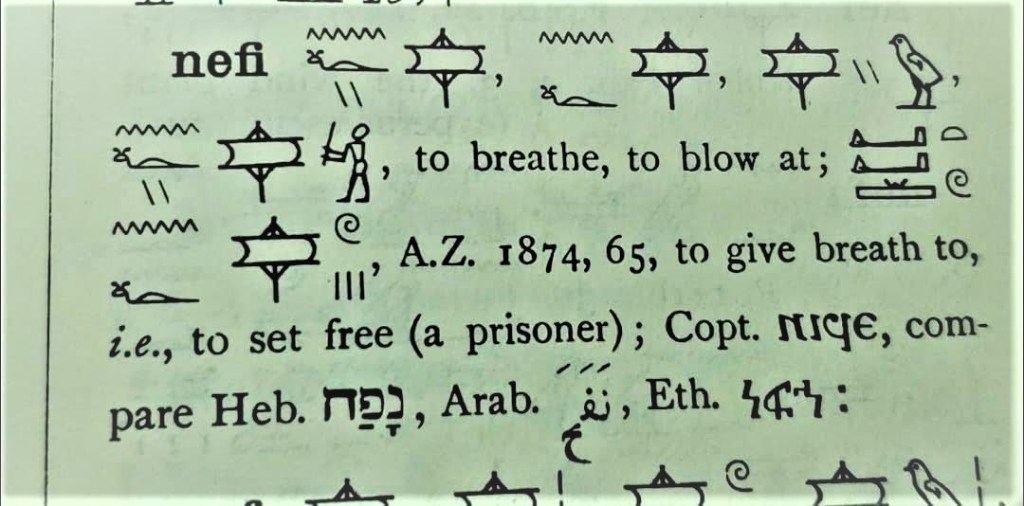
The name “Nefi” (Nephi) is an Egyptian word meaning “to breathe, to blow at; to give breath to, i.e. to set free (a prisoner)… compare Heb. נָפַח” (An Egyptian Hieroglyphic Dictionary; E.A. Wallis Budge; Dover Publications; New York; 1978; Volume 1, page 369, column b). This Egyptian word is actually derived from the Hebrew root Nafach (נָפַח) (Strong’s 5301) having the same meaning “to blow, to breathe.”
In these verses we have a Chiastic structure:
A. yes, having had a great knowledge of the goodness and the mysteries of Elohim,
B. therefore I make a record of my proceedings in my days.
C. Yes, I make a record in the language of my father,
D. which consists of the learning of the Y’hudim
C. and the language of the Egyptians.
B. And I know that the record which I make is true; and I make it with my own hand,
A. and I make it according to my knowledge.
The center point of this Chiastic structure is “learning of the Y’hudim (Jews)” In a chiastic structure, the center point of the chiasm represents the most important point in the structure. In this case, the most important point is “the learning of the Y’hudim (Jews)” revealing to us that the “learning of the Jews” is a key to understanding the Stick of Joseph.
Years later Nefi would write:
For I came out from Yerushalayim, and my eyes have beheld the things of the Y’hudim, and I know that the Y’hudim do understand the things of the prophets. And there is no other people that understand the things which were spoken unto the Y’hudim like unto them, except it be that they are taught after the manner of the things of the Y’hudim.
(2 Nefi 11:2 Stick of Joseph)
In the Commentary on the Book of Mormon Volume 1 by George Reynolds and Janne M. Sjodal (p. 4-6) we read of the phrase “learning of my father”:
The learning of my father. Hebrew learning, also called, “the learning of the Jews,” (v. 2), consisted, at this time, chiefly in a knowledge of the Law (Torah), now known as the Pentateuch; the Prophets down to and including Isaiah and some books now no longer extant… Besides the written word, the Jews had a venerable tradition by means of which the historical background of the records was preserved, and opinions, rulings, judgments, judicial decisions, customs and important incidents were transmitted by word of mouth from one generation to another generation…. Sometime after the destruction of the temple by Titus and the disposition of the people, the tradition was committed to writing. This literary composition is known as the “Mishna,” meaning “repetition.” Later, notes or commentaries were written on this text. These explanations are known as the “Gemara,” or “complement.” The Mishna and Gemara together constitute the Talmud (“instruction”), of which there are two versions: one composed at Jerusalem (about 390 A.D.), and one at Babylon (about 420 A.D.). The Talmud is by far the most important literary work of the adherents of the Mosaic faith, next after the inspired writings of the Old Testament. … Curiously enough, some modern critics have belittled the Talmud, very much in the same spirit as that by certain readers of the Book of Mormon… Nephi could, of course, not be familiar with the Talmud, as known in modern times, but the essence of that volume is much older than the books containing it. It gives us an idea of “the learning of the Jews.”
“the language of my father, which consists of the learning of the Y’hudim and the language of the Egyptians.” That is the spoken language of Nefi’s Father and the Jews (Hebrew) and the written language (script) of the Egyptians. Much later in the Stick of Joseph we are told:
32 And now, behold, we have written this record according to our knowledge, in the characters which are called among us the reformed Egyptian, being handed down and altered by us, according to our manner of speech.
33 And if our plates had been sufficiently large we should have written in Hebrew; but the Hebrew hath been altered by us also; and if we could have written in Hebrew, behold, ye would have had no imperfection in our record.
34 But the Lord knoweth the things which we have written, and also that none other people knoweth our language; and because that none other people knoweth our language, therefore he hath prepared means for the interpretation thereof.
(Mormon 9:32-34 (4:98-100 RLDS)
If we take all of this information together it appears that “the language of my father” (1Nephi 1:2) was the Hebrew dialect while “the language of the Egyptians” actually refers to the written language of the Egyptians and which Mormon 9:32 calls “the characters which are called among us the reformed Egyptian”. The phrase “the learning of the Jews and the language of the Egyptians” (1Nephi 1:2) means that the record was written in the Hebrew dialect, but with a form of Egyptian Characters.
(In fact several ancient examples have been found of texts written in the Hebrew or Aramaic dialects but in Egyptian characters. See Jewish and Other Semitic Texts Written in Egyptian Characters by John A. Tvedtnes and Stephen D. Ricks )
Joseph Smith himself seemed to have confirmed that regardless of what type of “characters” were used, the Book of Mormon was written in Hebrew. Speaking of the Title page of the Book of Mormon, Smith wrote:
“The title-page of the Book of Mormon is a literal translation, taken from the very last leaf, on the left hand side of the collection or book of plates, which contained the record which has been translated, the language of the whole running the same as all Hebrew writing in general; and that said title page is not by any means a modern composition, either of mine or of any other man who has lived or does live in this generation”
(History of the Church, 1:71)
For it came to pass in the commencement of the first year of the reign of Tzidkiyahu, king of Y’hudah — my father Lechi having dwelt at Yerushalayim in all his days — and in that same year there came many prophets, prophesying unto the people that they must repent or the great city Yerushalayim must be destroyed.
(1Nephi 1:4 LDS; 1:3 RLDS; 1:2 Stick of Joseph)
Nebuchadnezzar placed Jehoiachin’s twenty-one-year-old (2Chron. 36:11) uncle, Mattaniah on the throne under the name King Zedekiah (Tzidkiyahu) in late 597 or early 596 BCE:
17 And the king of Babylon made Mattaniah his father’s brother king in his stead, and changed his name to Zedekiah.
18 Zedekiah was twenty and one years old when he began to reign, and he reigned eleven years in Jerusalem. And his mother’s name was Hamutal, the daughter of Jeremiah of Libnah.
(2Kings 24:17-18 KJV)
and in that same year there came many prophets, prophesying unto the people that they must repent or the great city Yerushalayim must be destroyed.
As we read in 2Chronicles:
15 And the LORD God of their fathers sent to them by his messengers, rising up betimes, and sending; because he had compassion on his people, and on his dwelling place:
16 But they mocked the messengers of God, and despised his words, and misused his prophets, until the wrath of the LORD arose against his people, till there was no remedy.
(2Chron. 36:15-16 KJV)
And in Jeremiah:
And now, because ye have done all these works, saith the LORD, and I spake unto you, rising up early and speaking, but ye heard not; and I called you, but ye answered not;
(Jer. 7:13 KJV)
Since the day that your fathers came forth out of the land of Egypt unto this day I have even sent unto you all my servants the prophets, daily rising up early and sending them:
(Jer 7:25 KJV)
or the great city Yerushalayim must be destroyed. As Jeremiah prophesied:
17 Then rose up certain of the elders of the land, and spake to all the assembly of the people, saying,
18 Micah the Morasthite prophesied in the days of Hezekiah king of Judah, and spake to all the people of Judah, saying, Thus saith the LORD of hosts; Zion shall be plowed like a field, and Jerusalem shall become heaps, and the mountains of the house as the high places of a forest.
19 Did Hezekiah king of Judah and all Judah put him at all to death? did he not fear the LORD, and besought the LORD, and the LORD repented him of the evil which he had pronounced against them? Thus might we procure great evil against our souls.
20 And there was also a man that prophesied in the name of the LORD, Urijah the son of Shemaiah of Kirjath-jearim, who prophesied against this city and against this land according to all the words of Jeremiah:
(Jeremiah 26:17-20 KJV)
Wherefore, it came to pass that my father Lechi, as he went forth, prayed unto YHWH, yes, even with all his heart in behalf of his people. And it came to pass as he prayed unto YHWH, there came a pillar of fire and dwelt upon a rock before him, and he saw and heard much. And because of the things which he saw and heard, he did quake and tremble exceedingly.
(1Nefi 1:3 Stick of Joseph; 1:4-5 RLDS; 1:5-6 LDS)
pillar of fire The children of Israel were led thru the wilderness by the pillar of cloud by day and pillar of fire by night (Ex. 13:21-22; 14:24; Num. 14:14). In the Zohar we read “R. Simeon said that the pillar of cloud by day represented Abraham (Mercy), and the pillar of fire by night, Isaac (Severity),…” (Zohar 2:51b). Lechi was praying for mercy (chesed) for his people, but the pillar of fire appeared, giving him an answer of severity/judgment (gevurah).
The Torah refers to this pillar when we read:
20 Behold, I send an Angel before you, to keep you in the way, and to bring you into the place which I have prepared.
21 Beware of him, and obey his voice, provoke him not; for he will not pardon your transgressions: for my name is in him.
22 But if you shall indeed obey his voice, and do all that I speak; then I will be an enemy unto your enemies, and an adversary unto your adversaries.
23 For my Angel shall go before you, and bring you in unto the Amorites, and the Hittites, and the Perizzites, and the Canaanites, and the Hivites, and the Jebusites: and I will cut them off.
(Exodus 23:20-23 KJV)
There is a debate about this passage, recorded in the Talmud, between the “Minim” (Believers in Yeshua the Messiah) and Rabbi Idith:
R. Nahman said: He who is as skilled in refuting the Minim as is R. Idith, let him do so; but not otherwise. Once a Min said to R. Idith: It is written, And unto Moses He said, Come up to the Lord (Ex. 24:1). But surely it should have stated, Come up unto me! It was Metatron, he replied, whose name is similar to that of his Master, for it is written, For my name is in him (Ex. 23:21). But if so, [he retorted,] we should worship him! The same passage, however, — replied R. Idith says: Be not rebellious against him, i.e., exchange Me not for him. But if so, why is it stated: He will not pardon your transgression? He answered: By our troth we would not accept him even as a messenger, for it is written, And he said unto him, If Thy [personal] presence go not etc. (Ex. 33:15).
(b.Sanhedrin 38b)
The Kaarite author Kirkisani quoted this passage of Talmud with a variant reading saying “This is Metatron, who is the Lesser YHWH”.
The great Torah commentator Rashi writes of the phrase “since my name is in him” (Ex. 23:21):
for My Name is within him: [This clause] is connected to the beginning of the verse: Beware of him because My Name is associated with him. Our Sages, however, said: This is [the angel] Metatron, whose name is like the name of his Master (Sanh. 38b). The numerical value of מֵטַטְרוֹן [314] equals that of שַׁדַּי [314]. -[From Tikunei Zohar 66b]
The Torah commentator Nachmanides writes of the phrase “I am sending the angel before you” (Ex. 23:20):
…But the True interpretation of the angel whom they are promised here is that he is the “redeeming angel” of Gen. 48:16, who has God’s name “in him” (v. 21)- “For in Yah the LORD you have an everlasting Rock” (Is. 26:4). It was this angel that told Jacob, “I am the God of Beth-el” (Gen. 31:13), for it is the way of the King to swell in His House. though the text calls him an angel because the world is managed entirely under the particular divine aspect that he embodies. Our Sages call him Metatron, the one who shows the way, as I have already explained in my comment to 12:12.
And in his comment to Exodus 12:12 he writes, “…“Metatron” means “one who shows the way,” as in Sifrei, where the finger of God is the Metatron that points Moses toward the land of Israel…. “
And Rabbi Bechai wrote in his commentary to this passage:
“This Angel is not one of those (created) intelligences, which can sin, of whom it is said (Job 4:18), ‘His Angels He charged with folly,’ and this folly (appeared) when they assumed to themselves the power, that they were destroying Sodom (Gen 19:13) (lit., in the case of Sodom, when they said, ‘We are destroying’). But this Angel is one of the Inherent Ones” (according to the opinion of Tanchum – a high authority).
“For He will not pardon your transgressions.” Because He belongs to that class of Beings which cannot sin, yea, He is Metatron, the Prince of His (God’s) countenance, and therefore it is said: “to keep thee in the way.” The Targum translates keeping (משמרת) with guard (מטרת), so that Metatron (מטטרון) signifies a guard (or watchman) which (office) expresses His attribute of justice; thus He says, “before thy face”; as the expression occurs (Hab 3:5), “Before His face went the pestilence, and burning coals (burning death) went forth at His feet.”
And He says, Mine ANGEL; by which He would say, Mine ANGEL, who is my beloved One, through whom I am made known in the world, and concerning whom it is written (Exo 33:14), “My presence (lit., face or express image) shall go with thee.”
When Moses begged of God, saying (v 13), “Show me now Thy way,” he besought from Him something (a revelation of one of His attributes) by which he might know Him, and He replied: “My presence shall go”; (this presence or countenance, an express image) is He of whom it is written, (Isa 63:9), “The Angel of His countenance saved them,” namely, the Angel who is God’s countenance; therefore He said (Exo 23:22), “I will be an adversary to thine adversaries through Him,” and He adds (v 23), “And I will cut them off”; because on account of His attribute of justice are His enemies cut off.
With reference to His being called Angel, you will know that He is not one of those created intelligences, because the world is governed by Him, for He is the very entity of justice.
It is said: “Beware of Him” (lit., beware from before His countenance), for, on account of the justice of God, man ought to watch himself that he be not punished for his sins; thus He mentions with reference to Him (this Angel) “Watching” and “countenance.”* “Obey His voice.” There is a warning that they should not vex the INHERENT ONES in the Godhead, therefore there is immediately added: “Provoke Him not,” which words our Rabbis of blessed memory have explained: “Do not provoke Me in Him,” but let him bear in mind that all are One, and all are the only One God, without being divided.
“For He will not pardon your transgressions.” Although this Angel has power to forgive sins, and the power of pardon is delivered into His hand, yet He will not pardon your sins, if you provoke Him; because whoever provokes Him, provokes my name, that is, provokes God in Him. When David, of blessed memory, said, Psalm 130:4: “But there is forgiveness with thee,” our Rabbis of blessed memory were of opinion, that such power to forgive sin is not delivered to any of the created intelligences.
* The meaning is: Watch thyself not to fall into sin, because this Angel is the express image of God’s countenance; God’s attributes are revealed in Him.
The Zohar identifies Metatron as the Middle Pillar of the Godhead:
The Middle Pillar [of the Godhead] is Metatron,
Who has accomplished peace above,
according to the glorious state there.
(Zohar 3:227)
And according to the Zohar the Middle Pillar of the Godhead is the “Son of Yah”:
Better is a neighbor that is near, than a brother far off.
This neighbor is the Middle Pillar in the Godhead,
which is the Son of Yah.
(Zohar 2:115)
According to Philo of Alexandria, this Angel was a manifestation of the Word (Logos):
For God, like a shepherd and a king, governs (as if they were a flock of sheep) the earth, and the water, and the air, and the fire, and all the plants, and living creatures that are in them, whether mortal or divine; and he regulates the nature of the heaven, and the periodical revolutions of the sun and moon, and the variations and harmonious movements of the other stars, ruling them according to law and justice; appointing, as their immediate superintendent, his own right reason (Logos), his first-born son, who is to receive the charge of this sacred company, as the lieutenant of the great king; for it is said somewhere, “Behold, I am he! I will send my messenger before thy face, who shall keep thee in the Road.”(Ex 23:20.) (52) Let therefore all the world, the greatest and most perfect flock of the living God, say “The Lord is my shepherd, and he shall cause me to lack nothing,” (Ps. 23:1) (53) and let every separate individual say the same thing; not with the voice which proceeds from his tongue and his mouth, extending only through a scanty portion of the air, but with the wide spreading voice of the mind, which reaches to the very extremities of this universe; for it is impossible that there should be a deficiency of anything that is necessary, where God presides, who is in the habit of bestowing good things in all fulness and completeness in all living beings.
(On Husbandry 51b-55)
(174) for until a man is made perfect he uses divine reason (Logos) as the guide of his path, for that is the sacred oracle of scripture: “Behold, I send my angel before thy face that he may keep thee in the road, so as to lead thee into the land which I have prepared for thee. Attend thou to him, and listen to him; do not disobey him; for he will not pardon your transgressions, for my name is in Him.” (Ex 23:20-21.) (175) But when he has arrived at the height of perfect knowledge, then, running forward vigorously, he keeps up with the speed of him who was previously leading him in his way; for in this way they will both become attendants of God who is the guide of all things; no one of those who hold erroneous opinions accompanying them any longer, and even Lot himself, who turned on one side the soul, which might have been upright and inflexible, removing and living at a distance.
(Migration of Abraham 174-175)
So the Pillar of Fire that appeared to Lechi was a manifestation of Metatron, the Word, the Firstborn Son of Yah.
dwelt upon a rock – The underlying Hebrew word is most likely yashav ישב (Strong’s 3427), meaning “to sit or to dwell.” The noun form is yeshiva. It is interesting to note that this same word correlates with the Uto – Aztecan word yesipa, which has exactly the same range of meaning.
Under Construction
This research and this page are made possible by donations from our readers. Please consider supporting this work with a donation.
Donate to Support this Site and Research
Under Construction
 Restoration Torah Research