LDS Chapter 3
And it came to pass that the brother of Yered — now the number of the vessels which had been prepared was eight — therefore the brother of Yered went forth unto the mount which they called mount Shelem because of its great height, and did molten out of a rock sixteen small stones; and they were white and clear, even as transparent glass. And he did carry them in his hands up on the top of the mount, and cried again unto YHWH, saying, O YHWH, you have said that we must be encompassed about by the floods. Now behold, O YHWH, and do not be angry with your servant because of his weakness before you, for we know that you are holy and dwell in the Heavens, and that we are unworthy before you — because of the fall, our natures have become evil continually; nevertheless, O YHWH, you have given us a mitzvah that we must call upon you, that from you we may receive according to our desires. Behold, O YHWH, you have afflicted us because of our iniquity and have driven us forth, and for these many years we have been in the wilderness; nevertheless, you have been merciful unto us. O YHWH, look upon me in pity, and turn away your anger from this your people, and allow not that they shall go forth across this raging deep in darkness, but behold these things which I have molten out of the rock. And I know, O YHWH, that you have all power and can do whatsoever you will for the benefit of man. Therefore, touch these stones, O YHWH, with your finger, and prepare them that they may shine forth in darkness, and they shall shine forth unto us in the vessels which we have prepared, that we may have light while we shall cross the sea. Behold, O YHWH, you can do this. We know that you are able to show forth great power which looks small unto the understanding of men.
And it came to pass that when the brother of Yered had said these words, behold, YHWH stretched forth his hand and touched the stones one by one with his finger. ”
(‘Eter 1:11-12; RLDS 1:60-89; LDS 3:1-24)
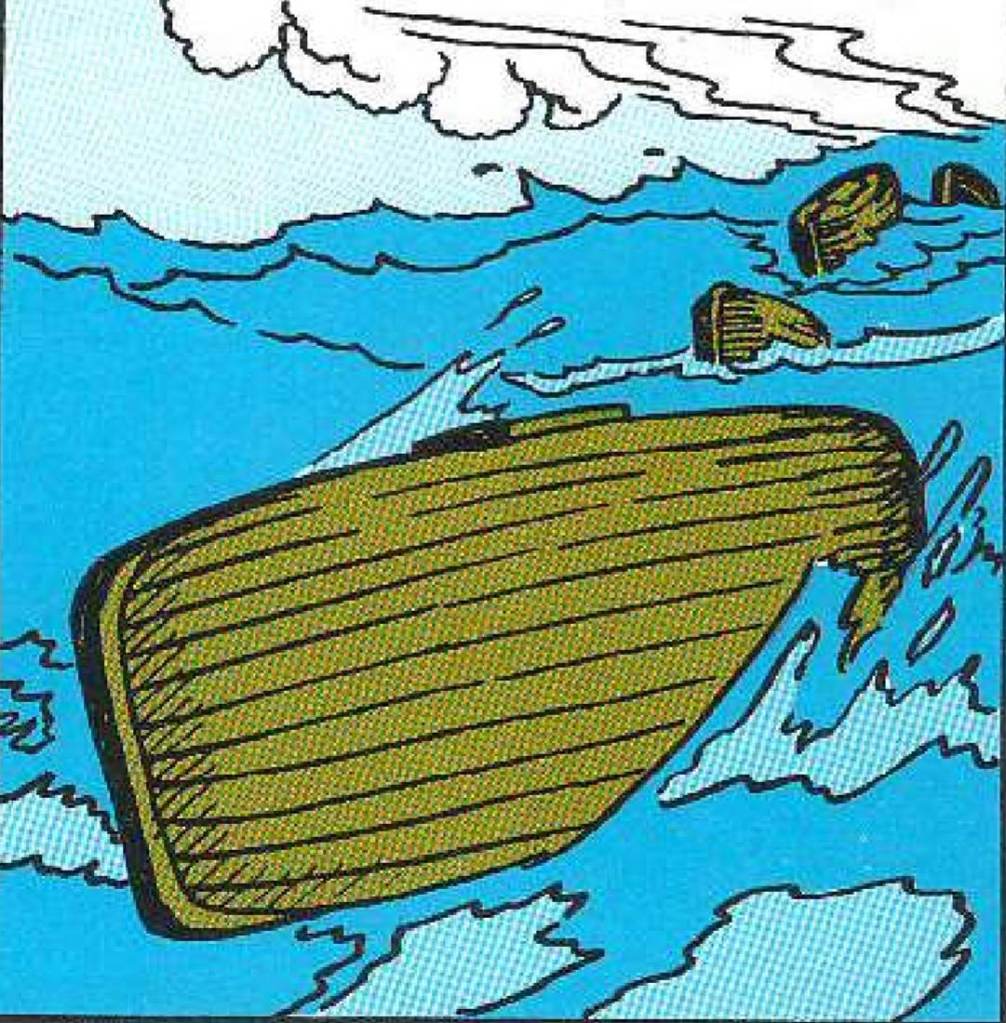
This miracle has an amazing parallel in a Jewish tradition concerning another water-going vessel—Noach’s ark—and how it was lit when it was sealed shut. In Genesis 6:16, we read the following:
A window shalt thou make to the ark, and in a cubit shalt thou finish it above; and the door of the ark shalt thou set in the side thereof; with lower, second, and third stories shalt thou make it.
(Gen. 6:16 KJV)
The Hebrew word translated “window” in this verse is actually the Hebrew word Tzohar (צֹ֣הַר), which literally means “that which shines”. We read in Genesis Rabbah to this passage:
A LIGHT (ZOHAR) SHALT THOU MAKE TO THE ARK (VI, 16). R. Hunia and R. Phinehas, R. Hanan and R. Hoshaia could not explain [the meaning of ZOHAR]; R. Abba b. Kahana and R. Levi did explain it. R. Abba b. Kahana said: It means a skylight; R. Levi said: A precious stone.
(Midrash Rabbah XXXI:11 to Genesis 6:16)
Rashi (1040-1105 CE) says of this word: “Some say [that it was] a window, and some say [that it was] a precious stone, which gave them light. — [Gen. Rabbah 31:11]”
The Jewish Commentator Rabbi David Kimhi (1160?-1235? CE) writes in his commentary to this word: “Some of our Sages understand the Hebrew word to indicate a precious stone that would glow to provide light, but the instruction to ‘make’ argues against that.”
It is interesting to note that the Stick of Joseph resolves Kimhi’s objection based on the word “make” in Gen. 6:16, because in the account of the Stick of Joseph, the brother of Yered “made” the stones, in that he did “did molten out of a rock sixteen small stones; and they were white and clear, even as transparent glass” and that when they were touched by the finger of YHWH they did “shine forth in darkness.”
13 And when he had said these words, behold, YHWH showed himself unto him and said, Because you know these things, you are redeemed from the Fall. Therefore, you are brought back into my presence; therefore I show myself unto you. Behold, I am he who was prepared from the foundation of the world to redeem my people. Behold, I am Yeshua HaMashiach. I am the Father and the Son. In me shall all mankind have life; and that eternally, even they who shall believe on my name. And they shall become my sons and my daughters. And to none of those now living whom I created have I appeared, for none have believed in me as you have. Do you see that you are created after my own image? Yes, even all men were created in the beginning after my own image. Behold, this body which you now behold is the body of my spirit. And man have I created after the body of my spirit. And even as I appear unto you to be in the spirit will I appear unto my people in the flesh.
14 And now as I, M’roni, said I could not make a full account of these things which are written, therefore it suffices me to say that Yeshua showed himself unto this man in the spirit, even after the manner and in the likeness of the same body even as he showed himself unto the Nefites. And he ministered unto him even as he ministered unto the Nefites, and all this that this man might know that he was Elohim, because of the many great works which YHWH had shown unto him. And because of the knowledge of this man, he could not be kept from beholding within the veil. And he saw the finger of Yeshua, which when he saw, he fell with fear, for he knew that it was the finger of YHWH. And he had faith no longer, for he knew, nothing doubting. Wherefore, having this perfect knowledge of Elohim, he could not be kept from within the veil.25 Therefore, he saw Yeshua, and he did minister unto him.
(‘Eter 1:13-14; RLDS: 1 :76-78; LDS 3:13-20)
In his comment to Exodus 12:12 the great Torah commenator Nachmanides writes, “…“Metatron” means “one who shows the way,” as in Sifrei, where the finger of God is the Metatron that points Moses toward the land of Israel…. “
And he writes of the phrase “I am sending the angel before you” (Ex. 23:20):
…But the True interpretation of the angel whom they are promised here is that he is the “redeeming angel” of Gen. 48:16, who has God’s name “in him” (v. 21)- “For in Yah the LORD you have an everlasting Rock” (Is. 26:4). It was this angel that told Jacob, “I am the God of Beth-el” (Gen. 31:13), for it is the way of the King to swell in His House. though the text calls him an angel because the world is managed entirely under the particular divine aspect that he embodies. Our Sages call him Metatron, the one who shows the way, as I have already explained in my comment to 12:12.
Rashi writes of the same phrase “since my name is in him” (Ex. 23:21):
for My Name is within him: [This clause] is connected to the beginning of the verse: Beware of him because My Name is associated with him. Our Sages, however, said: This is [the angel] Metatron, whose name is like the name of his Master (Sanh. 38b). The numerical value of מֵטַטְרוֹן [314] equals that of שַׁדַּי [314]. -[From Tikunei Zohar 66b]
And Rabbi Bechai wrote in his commentary to this passage:
“This Angel is not one of those (created) intelligences, which can sin, of whom it is said (Job 4:18), ‘His Angels He charged with folly,’ and this folly (appeared) when they assumed to themselves the power, that they were destroying Sodom (Gen 19:13) (lit., in the case of Sodom, when they said, ‘We are destroying’). But this Angel is one of the Inherent Ones” (according to the opinion of Tanchum – a high authority).
“For He will not pardon your transgressions.” Because He belongs to that class of Beings which cannot sin, yea, He is Metatron, the Prince of His (God’s) countenance, and therefore it is said: “to keep thee in the way.” The Targum translates keeping (משמרת) with guard (מטרת), so that Metatron (מטטרון) signifies a guard (or watchman) which (office) expresses His attribute of justice; thus He says, “before thy face”; as the expression occurs (Hab 3:5), “Before His face went the pestilence, and burning coals (burning death) went forth at His feet.”
And He says, Mine ANGEL; by which He would say, Mine ANGEL, who is my beloved One, through whom I am made known in the world, and concerning whom it is written (Exo 33:14), “My presence (lit., face or express image) shall go with thee.”
When Moses begged of God, saying (v 13), “Show me now Thy way,” he besought from Him something (a revelation of one of His attributes) by which he might know Him, and He replied: “My presence shall go”; (this presence or countenance, an express image) is He of whom it is written, (Isa 63:9), “The Angel of His countenance saved them,” namely, the Angel who is God’s countenance; therefore He said (Exo 23:22), “I will be an adversary to thine adversaries through Him,” and He adds (v 23), “And I will cut them off”; because on account of His attribute of justice are His enemies cut off.
With reference to His being called Angel, you will know that He is not one of those created intelligences, because the world is governed by Him, for He is the very entity of justice.
It is said: “Beware of Him” (lit., beware from before His countenance), for, on account of the justice of God, man ought to watch himself that he be not punished for his sins; thus He mentions with reference to Him (this Angel) “Watching” and “countenance.”* “Obey His voice.” There is a warning that they should not vex the INHERENT ONES in the Godhead, therefore there is immediately added: “Provoke Him not,” which words our Rabbis of blessed memory have explained: “Do not provoke Me in Him,” but let him bear in mind that all are One, and all are the only One God, without being divided.
“For He will not pardon your transgressions.” Although this Angel has power to forgive sins, and the power of pardon is delivered into His hand, yet He will not pardon your sins, if you provoke Him; because whoever provokes Him, provokes my name, that is, provokes God in Him. When David, of blessed memory, said, Psalm 130:4: “But there is forgiveness with thee,” our Rabbis of blessed memory were of opinion, that such power to forgive sin is not delivered to any of the created intelligences.
The Zohar identifies Metatron as the Middle Pillar of the Godhead:
The Middle Pillar [of the Godhead] is Metatron,
Who has accomplished peace above,
according to the glorious state there.
(Zohar 3:227b)
And according to the Zohar the Middle Pillar of the Godhead is the “Son of Yah”:
Better is a neighbor that is near, than a brother far off.
This neighbor is the Middle Pillar in the Godhead,
which is the Son of Yah.
(Zohar 2:115b)
The Second Temple Era Jewish writer Philo of Alexandria writes of Exodus 23:20-21, saying that this same figure is “The Word” and “his first-born son”:
For God, like a shepherd and a king, governs (as if they were a flock of sheep) the earth, and the water, and the air, and the fire, and all the plants, and living creatures that are in them, whether mortal or divine; and he regulates the nature of the heaven, and the periodical revolutions of the sun and moon, and the variations and harmonious movements of the other stars, ruling them according to law and justice; appointing, as their immediate superintendent, his own right reason (Logos, the Word), his first-born son, who is to receive the charge of this sacred company, as the lieutenant of the great king; for it is said somewhere, “Behold, I am he! I will send my messenger before thy face, who shall keep thee in the Road.”(Ex 23:20.) (52) Let therefore all the world, the greatest and most perfect flock of the living God, say “The Lord is my shepherd, and he shall cause me to lack nothing,” (Ps. 23:1) (53) and let every separate individual say the same thing; not with the voice which proceeds from his tongue and his mouth, extending only through a scanty portion of the air, but with the wide spreading voice of the mind, which reaches to the very extremities of this universe; for it is impossible that there should be a deficiency of anything that is necessary, where God presides, who is in the habit of bestowing good things in all fulness and completeness in all living beings.
(On Husbandry 51b-55)
Under Construction
Return to Stick of Joseph Commentary Page
This research and this page are made possible by donations from our readers. Please consider supporting this work with a donation.
 Restoration Torah Research