1 In the land of the Chaldeans, at the residence of my fathers, I, Abraham, saw that it was needful for me to obtain another place of residence.
2 And, finding there was greater happiness and peace and rest for me, I sought for the blessings of the fathers, and the right whereunto I should be ordained to administer the same; having been myself a follower of righteousness, desiring also to be one who possessed great knowledge, and to be a greater follower of righteousness, and to possess a greater knowledge, and to be a father of many nations, a prince of peace, and desiring to receive instructions, and to keep the commandments of God, I became a rightful heir, a High Priest, holding the right belonging to the fathers.
(Abraham 1:1-2)
The typical non-Jewish reader might be surprised by the idea that Abraham obtained the priesthood and was a “High Priest”, however this is made plain in the Midrash Rabbah:
AND SAID UNTO HIM: ABRAHAM; AND HE SAID: HERE AM I (ib.). R. Joshua said: On two occasions Moses compared himself to Abraham, and God answered him, Glorify not thyself in the presence of the king, and stand not in the place of great men (Prov. XXV, 6). Now Abraham said, HERE AM I-ready for priesthood, ready for kingship, and he attained priesthood and kingship. He attained priesthood, as it says, The Lord hath sworn, and will not repent: Thou art a priest for ever after the manner of Melchizedek (Ps. CX, 4); kingship: Thou art a mighty prince among us (Gen. XXIII, 5).
(Midrash Rabbah Genesis 55:6)
And:
R. Ishmael said: Abraham was a High Priest, as it says, The Lord hath sworn, and will not repent: Thou art a priest for ever after the manner of Melchizedek (Ps. CX, 4).
(Midrash Rabbah Genesis 46:5)
3 It was conferred upon me from the fathers; it came down from the fathers, from the beginning of time, yea, even from the beginning, or before the foundation of the earth, down to the present time, even the right of the firstborn, or the first man, who is Adam, or first father, through the fathers unto me.
4 I sought for mine appointment unto the Priesthood according to the appointment of God unto the fathers concerning the seed.
(Abraham 1:3-4)
According to the Talmud, Abraham received this priesthood from Melchizedek, whom the Talmud identifies as Abraham’s direct ancestor Shem, thus conferred upon him literally from his “fathers”:
R. Zechariah said on R. Ishmael’s authority: The Holy One, blessed be He, intended to bring forth the priesthood from Shem, as it is written, And he [sc. Melchizedek] was the priest of the most high God.(Gen. 14:18) But because he gave precedence in his blessing to Abraham over God, He brought it forth from Abraham; as it is written, And he blessed him and said. Blessed be Abram of the most high God, possessor of heaven and earth, and blessed be the most high God. (Gen. 14:19f) Said Abraham to him, ‘Is the blessing of a servant to be given precedence over that of his master?’ Straightway it [the priesthood] was given to Abraham, as it is written, The Lord said unto my Lord (i.e. Abraham see Ber. 7b), Sit thou at my right hand, until I make thine enemies thy footstool; (Ps. 110:1) which is followed by, The Lord hath sworn, and will not repent, Thou art a priest for ever, after the order of Melchizedek,’(Ps. 110:4) meaning, ‘because of the words of Melchizedek.’ Hence it is written, And he was a priest of the most High God, [implying that] he was a priest, but not his seed.
(b.Nedarim 32b)
5 My fathers, having turned from their righteousness, and from the holy commandments which the Lord their God had given unto them, unto the worshiping of the gods of the heathen, utterly refused to hearken to my voice;
6 For their hearts were set to do evil, and were wholly turned to the god of Elkenah, and the god of Libnah, and the god of Mahmackrah, and the god of Korash, and the god of Pharaoh, king of Egypt;
(Abraham 1:5-6)
The Book of Abraham claims Abraham obtained the priesthood from “the fathers” (Abraham 1:3-4) but that his own father, Terah, had fallen into idolatry. This is in complete agreement with the Midrash Rabbah which not only records that Abraham’s father manufactured and worshipped idols, but that Abraham’s father refused to hearken to Abraham when Abraham attempted to demonstrate the errors of idolatry to him”
R. Hiyya said: Terah was a manufacturer of idols. He once went away somewhere and left Abraham to sell them in his place. A man came and wished to buy one. ‘ How old are you? ‘ Abraham asked him. ‘ Fifty years,’ was the reply. ‘ Woe to such a man!’ he exclaimed, ‘you are fifty years old and would worship a day-old object! ‘ At this he became ashamed and de-parted. On another occasion a woman came with a plateful of flour and requested him, ‘ Take this and offer it to them.’ So he took a stick, broke them, and put the stick in the hand of the largest. When his father returned he demanded, ‘What have you done to them?’ ‘I cannot conceal it from you,’ he rejoined. ‘A woman came with a plateful of fine meal and re-quested me to offer it to them. One claimed, “I must eat first,” while another claimed, ” I must eat first.” Thereupon the largest arose, took the stick, and broke them.’ ‘Why do you make sport of me,’ he cried out; ‘have they then any knowledge!’ ‘Should not your ears listen to what your mouth is saying,’ he retorted. There-upon he seized him and delivered him to Nimrod.
(Midrash B’reishit Rabbah 38:13)
Elkenah, See comments to the next verse
the god of Libnah, “…the name has actually turned up in the Egyptian records and been obligingly transposed into good Canaanite by Professor Max Burchardt as plain and simple Libnah, designated an unknown geographical region.” (An Approach to the Book of Abraham by Hugh Nibley p. 320-321)
the god of Mahmackrah, Though otherwise unknown, these syllables are not unlikely syllables for a Semitic word or name.
the god of Korash, Hebrw כורש Koresh (Cyrus) is actually Persian kwrws meaning “the Sun”. In the Apocalypse of Abraham, which is written in the first person by Abraham, and which has survived only in an old Slavanic version, we read that Avraham’s brother Nahor worshiped an idolatrous god called (in the Slavonic) “Zouchaios” or “Souzouch” (depending on how one renders the Slavonic into English) (Apoc. Abr. 6:9) “which is probably a transcription of the name kwrws (Cyrus)” (Old Testament Pseudepigrapha Volume 1 page 682).
the god of Pharaoh, king of Egypt; The Egyptian god Sobek, commonly depicted as a crocodile.
7 Therefore they turned their hearts to the sacrifice of the heathen in offering up their children unto these dumb idols, and hearkened not unto my voice, but endeavored to take away my life by the hand of the priest of Elkenah. The priest of Elkenah was also the priest of Pharaoh.
(Abraham 1:7)
It is unclear whether Elkanah is the name of a pagan god, or something that a pagan god was “god of” (see previous verse). Who was the god of “Elkanah” in the Book of Abraham? From Facsimile 1 Figure 5 we know he must correspond with the Egyptian god Qebehsenuef, one of the four sons of the Egyptian god Horus. In Hebrew the word is clearly a composite of “El” (god) and “Kanah” There are several possibilities for the meaning of “Kanah” in Hebrew or Aramaic (“Chaldean”). In Hebrew this could be קנא “jealous” or “zealous” it could also be קנה mean “to buy or acquire” spelled קנא in Aramaic related to Hebrew קנין (Kin’yan) meaning “possession, wealth”. Another possibility is a short form for “God of Canaan”.
The Midrash Rabbah continues its own parallel account (from the citation given in comment to Abr. 1:5-6) to say that Nimrod (King of Babylon at the time) ordered Abraham to be thrown into a fiery furnace as an act of worship of fire:
R. Hiyya said: Terah was a manufacturer of idols. He once went away somewhere and left Abraham to sell them in his place. A man came and wished to buy one. ‘ How old are you? ‘ Abraham asked him. ‘ Fifty years,’ was the reply. ‘ Woe to such a man!’ he exclaimed, ‘you are fifty years old and would worship a day-old object! ‘ At this he became ashamed and de-parted. On another occasion a woman came with a plateful of flour and requested him, ‘ Take this and offer it to them.’ So he took a stick, broke them, and put the stick in the hand of the largest. When his father returned he demanded, ‘What have you done to them?’ ‘I cannot conceal it from you,’ he rejoined. ‘A woman came with a plateful of fine meal and re-quested me to offer it to them. One claimed, “I must eat first,” while another claimed, ” I must eat first.” Thereupon the largest arose, took the stick, and broke them.’ ‘Why do you make sport of me,’ he cried out; ‘have they then any knowledge!’ ‘Should not your ears listen to what your mouth is saying,’ he retorted. There-upon he seized him and delivered him to Nimrod.
(Midrash B’reishit Rabbah 38:13)
From Abraham 1:14 and Facsimile 1 Figure 5 we know he must correspond with the Egyptian god Qebehsenuef, one of the four sons of the Egyptian god Horus. Each of the four sons of Horus (depicted in Facsimile 1 Figures 5, 6, 7 and 8) were believed to correspond to each of the four elements as understood by the ancients: earth, water, air/wind and fire. Qebehsenuef was believed to correspond with the element of fire. Thus in the Midrash Rabbah Nimrod says “‘we will worship nought but the fire” and thus the Book of Abraham says that they “endeavored to take away” Abraham’s “life by the hand of the priest of Elkenah” (Elkenah being synonymous with Qebehsenuef corresponding with fire.)
The following chart shows the traditional correspondences for each of these four sons of Horus:
| In Facsimile 1 | Son of Horus | Head | Part of body placed in canopic jar | Direction | Element | People |
| Figure 5 Elkenah | Qebehsenuef | falcon | intestines | west | fire | |
| Figure 6 Libnah | Duamutef | jackal | stomach | east | earth | |
| Figure 7 Mahmackrah | Hapi (Xapi) | baboon | lungs | north | water | |
| Figure 8 Korash | Imsety | human | liver | south | air |
These same four figures appear as figure 6 of Facsimile 2 where they are correctly identified as representing “this earth in its four quarters”.
Together with Maa-atef-f, Kheri-beq-f, and Horus-Khenti-maa, the four sons of Horus were known as the Seven Shining Ones, protectors of the body of Osiris.
This has its parallel in the Book of Enoch to the four angels of the presence: Uriel/P’nu’el, Rafa’el. Mikha’el and Gavri’el (in 1Enoch 9 and 40) which added to the three angels Ra’u’el, Sari’el and Rumi’el are the seven “holy angels who watch” (1Enoch 20) suggesting that these “Seven Shining Ones” are a corruption of the seven “holy angels who watch” and that the seven sons of Horus are a corruption of the four angels of the presence.
How did the attempt to kill Abraham on a bedstand become an attempt to kill him in a fiery furnace? The Rabbinic Commentator Rashi may give us the answer. Rashi comments on the phrase “Ur of the Chaldees” in Gen. 11:28 by recounting the account found in Midrash Rabbah above and then commenting “When Abram was saved, they said to Haran, “Whose side are you on?” Haran said to them, “I am on Ab-ram’s side!” They cast him into the fiery furnace and he was burned. This is the meaning of אוּר כַּשְׂדִּים, the fire of the Chaldees.”
Thus the tradition of a fiery furnace may have been drawn from the phrase “Haran died… in Ur of the Chaldees” (Gen. 11:28 and Abr. 2:1) being misread to say that Haran dies “in the fire of the Chaldees”. A misreading of this phrase in Abraham 2:1 along with the account of the failed attempt to sacrifice Abraham (Abraham 1:7, 15-16) must have led to this tradition that the mode of sacrifice was a fiery furnace.
8 Now, at this time it was the custom of the priest of Pharaoh, the king of Egypt, to offer up upon the altar which was built in the land of Chaldea, for the offering unto these strange gods, men, women, and children.
9 And it came to pass that the priest made an offering unto the god of Pharaoh, and also unto the god of Shagreel, even after the manner of the Egyptians. Now the god of Shagreel was the sun.
(Abraham 1:8-9)
It appears that during this brief time, Chaldea had been conquered by Egypt.
Shagreel In his book An Approach to the Book of Abraham (p. 416) Hugh Nibley writes:
Note, however, that it was not Shagreel who was the sun but “the god of Shagreel.” And who was Shagreel himself? Another happy guess: The old desert tribes, whose beliefs and practices, as A. Alt has recently demonstrated at length, are of primary importance in understanding the background of the Abraham traditions, worshiped the star Sirius under the name of Shighre or Shaghre, and Shagre-el in their idiom means “Shagre is God.”
10 Even the thank-offering of a child did the priest of Pharaoh offer upon the altar which stood by the hill called Potiphar’s Hill, at the head of the plain of Olishem.
(Abraham 1:10)
Olishem “…can be readily recognized by any first-year Hebrew student as meaning something like ‘hill of heaven,’ ‘high place of heaven,’ or even ‘sun hill,’…” An Approach to the Book of Abraham by Hugh Nibley p. 415)
11 Now, this priest had offered upon this altar three virgins at one time, who were the daughters of Onitah, one of the royal descent directly from the loins of Ham. These virgins were offered up because of their virtue; they would not bow down to worship gods of wood or of stone, therefore they were killed upon this altar, and it was done after the manner of the Egyptians.
(Abraham 1:11)
Onitah
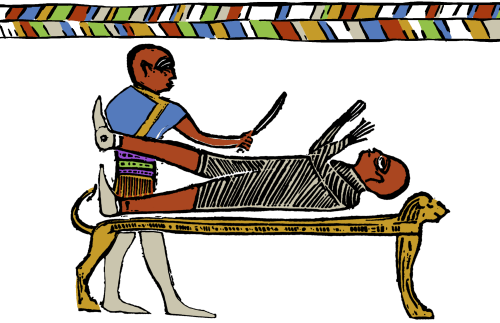
12 And it came to pass that the priests laid violence upon me, that they might slay me also, as they did those virgins upon this altar; and that you may have a knowledge of this altar, I will refer you to the representation at the commencement of this record.
13 It was made after the form of a bedstead, such as was had among the Chaldeans, and it stood before the gods of Elkenah, Libnah, Mahmackrah, Korash, and also a god like unto that of Pharaoh, king of Egypt.
(Abraham 1:12-13)
the form of a bedstead
14 That you may have an understanding of these gods, I have given you the fashion of them in the figures at the beginning, which manner of figures is called by the Chaldeans Rahleenos, which signifies hieroglyphics.
15 And as they lifted up their hands upon me, that they might offer me up and take away my life, behold, I lifted up my voice unto the Lord my God, and the Lord hearkened and heard, and he filled me with the vision of the Almighty, and the angel of his presence stood by me, and immediately unloosed my bands;
16 And his voice was unto me: Abraham, Abraham, behold, my name is Jehovah, and I have heard thee, and have come down to deliver thee, and to take thee away from thy father’s house, and from all thy kinsfolk, into a strange land which thou knowest not of;
(Abraham 1:14-16)
Abraham is here rescued when the “angel of the presence” stands by him. Similarly the Talmud says that when Abraham was thrown into the fiery furnace that the angel Gabriel came and cooled the fire:
When the wicked Nimrod cast our father Abraham into the fiery furnace, Gabriel said to the Holy One, blessed be He: ‘Sovereign of the Universe! Let me go down, cool [it], and deliver that righteous man from the fiery furnace.’
(b.Pess. 118a)
Under Construction
Return to Sefer Avraham Commentary
This research and this page are made possible by donations from our readers. Please consider supporting this work with a donation.
 Restoration Torah Research