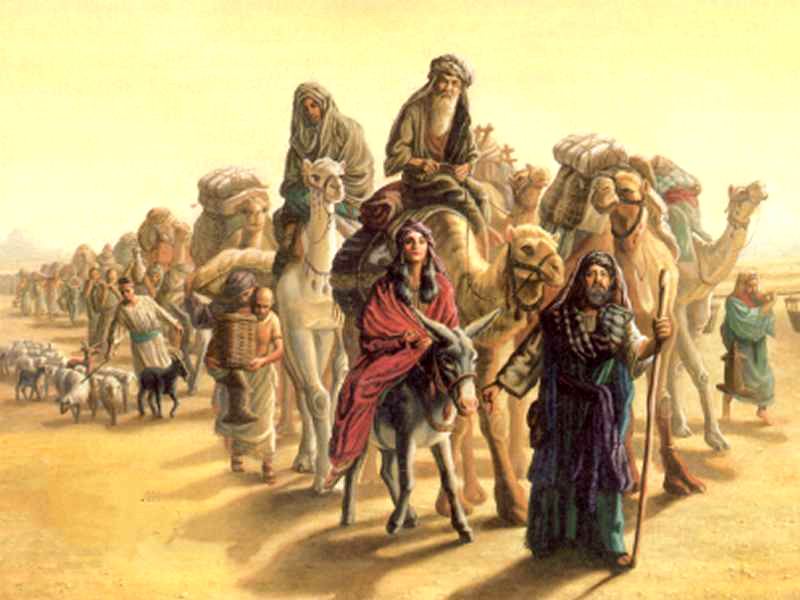
14 So I, Abraham, departed as the Lord had said unto me, and Lot with me; and I, Abraham, was sixty and two years old when I departed out of Haran.
15 And I took Sarai, whom I took to wife when I was in Ur, in Chaldea, and Lot, my brother’s son, and all our substance that we had gathered, and the souls that we had won in Haran, and came forth in the way to the land of Canaan, and dwelt in tents as we came on our way;
(Abraham 2:14-15)
The parallel text in Genesis reads:
4 So Abram departed, as the LORD had spoken unto him; and Lot went with him: and Abram was seventy and five years old when he departed out of Haran.
5 And Abram took Sarai his wife, and Lot his brother’s son, and all their substance that they had gathered, and the souls that they had gotten in Haran; and they went forth to go into the land of Canaan; and into the land of Canaan they came.
(Gen. 12:4-5 KJV)
The actual Hebrew for the word “they had gotten” in Gen. 12:5 is עָשׂ֣וּ which literally means “they had made” or “they had done”. The Midrash Rabbah to Genesis addresses this strange statement as follows:
AND ABRAM TOOK SARAI HIS WIFE, AND LOT THEIR BROTHER’S SON, AND ALL THEIR SUBSTANCE WHICH THEY HAD GATHERED, AND THE SOULS THAT THEY HAD MADE IN HARAN (XII, 5). R. Leazar observed in the name of R. Jose b. Zimra: If all the nations assembled to create one insect they could not endow it with life, yet you say, AND THE SOULS THAT THEY HAD MADE! It refers, however, to the proselytes [which they had made]. Then let it say, ‘ That they had converted ‘; why THAT THEY HAD MADE? That is to teach you that he who brings a Gentile near [to God] is as though he created him. Now let it say, ‘ That he had made ‘; why THAT THEY HAD MADE? Said R. Hunia: Abraham converted the men and Sarah the women.
(Genesis Rabbah 39:14)
This is exactly in keeping with the parallel statement in the Sefer Avraham that understands the “souls they had made” (in the first person) as “souls we had won.” i.e. proselytes.
Abraham, was sixty and two years old when I departed out of Haran – Genesis, even in Joseph Smith’s Inspired version, says he was seventy five. However the Book of Jasher indicates that Avraham left Haran twice. Initially leaving at the age of fifty (Jasher 13:5) , returning (Jasher 13:20), and then leaving again at seventy five (Jasher 13:26). If this is the case, perhaps Abraham 2:14-15 and Genesis 12:4-5 are abbreviating and combining the two departures, with Abraham 2:14-15 recording the earlier departure (but giving the age as sixty two rather than fifty).
22 And it came to pass when I was come near to enter into Egypt, the Lord said unto me: Behold, Sarai, thy wife, is a very fair woman to look upon;
23 Therefore it shall come to pass, when the Egyptians shall see her, they will say-She is his wife; and they will kill you, but they will save her alive; therefore see that ye do on this wise:
25 And it came to pass that I, Abraham, told Sarai, my wife, all that the Lord had said unto me-Therefore say unto them, I pray thee, thou art my sister, that it may be well with me for thy sake, and my soul shall live because of thee.
(Abraham 2:22-25)
Remarkably, in the Genesis Apocryphon, Abraham also receives such a revelation as a dream-vision from YHWH:
So I moved to [enter] the land of Egypt [ … … … ] I reache[d] the Carmona River, one of the branches of the river [ … … ]. Now we [ … ] our land, and I [cro]ssed the seven branches of this river which [ … … … ]. Now we passed out of our land and entered the land of the children of Ham, the land of Egypt. vacat
And I, Abram, dreamed a dream during the night of my entering the land of Egypt. I saw in my dream one cedar tree and one palm tree, [a very beautifu]l one, and huma[n] figures came and tried to chop down and uproot the cedar in order to leave the palm by itself. But the palm restrained (them) when she said, ‘Do not chop down the cedar, for both of us are from o[ne r]oot!’ And the cedar was left alone thanks to the protection of the palm and was not [chopped down]. vacat
I woke up from my dream in the night, and said to Sarai, my wife, ‘I have (just) dreamed a dream, [and I] am afraid [on account of] this dream!’ And she said to me, ‘Tell me your dream that I might know (it), and so I began to relate this dream to her. [And I revealed] to [her the meaning of that] dream, and I [said, ‘… …] for they will seek to kill me, but you they will spare [… …] this, every favor [which you must do for me] in every [place] where [we are, say] of me that “he is my brother,” and I will remain alive by your protection and survive thanks to you.’ [… … ‘they will try] to remove you from me and to kill me!’ And Sarai wept over my words that night.
This research and this page are made possible by donations from our readers. Please consider supporting this work with a donation.
Donate to support this Page and Research
Under Construction
 Restoration Torah Research