1 And I, Abraham, had the Urim and Thummim, which the Lord my God had given unto me, in Ur of the Chaldees;
2 And I saw the stars, that they were very great, and that one of them was nearest unto the throne of God; and there were many great ones which were near unto it;
3 And the Lord said unto me: These are the governing ones; and the name of the great one is Kolob, because it is near unto me, for I am the Lord thy God: I have set this one to govern all those which belong to the same order as that upon which thou standest.
4 And the Lord said unto me, by the Urim and Thummim, that Kolob was after the manner of the Lord, according to its times and seasons in the revolutions thereof; that one revolution was a day unto the Lord, after his manner of reckoning, it being one thousand years according to the time appointed unto that whereon thou standest. This is the reckoning of the Lord’s time, according to the reckoning of Kolob.
(Avraham 3:1-4)
According to the explanation to Facsimile 2 Figure 5, the Sun “borrow[s] its light from Kolob”. The First Century Jewish writer Philo of Alexandria writes:
(30) And air and light he considered worthy of the pre-eminence. For the one he called the breath of God, because it is air, which is the most life-giving of things, and of life the causer is God; and the other he called light, because it is surpassingly beautiful: for that which is perceptible only by intellect is as far more brilliant and splendid than that which is seen, as I conceive, the sun is than darkness, or day than night, or the intellect than any other of the outward senses by which men judge (inasmuch as it is the guide of the entire soul), or the eyes than any other part of the body. (31) And the invisible divine reason, perceptible only by intellect, he calls the image of God. And the image of this image is that light, perceptible only by the intellect, which is the image of the divine reason [Logos], which has explained its generation. And it is a star above the heavens, the source of those stars which are perceptible by the external senses, and if any one were to call it universal light he would not be very wrong; since it is from that the sun and the moon, and all the other planets and fixed stars derive their due light, in proportion as each has power given to it; that unmingled and pure light being obscured when it begins to change, according to the change from that which is perceptible only by the intellect, to that which is perceptible by the external senses; for none of those things which are perceptible to the external senses is pure.(Philo; On Creation 30-31)
The Greek word Philo uses for “divine reason” is “Logos” which is the “Word” (as in the Greek text of John 1:1-3)
If we understand these passages in light of Philo of Alexandria’s statement, then Kolob is the ideal model or idea of a Star, after which all stars, including our own Sun, were modeled. This in keeping with the idea found in Chapters 4 and 5, as well as the Joseph Smith Translation of Genesis Chapters 1 and 2, that the Universe existed as a plan, before it was brought forth into reality.
one revolution was a day unto the Lord, after his manner of reckoning, it being one thousand years as we read in Psalms:
For a thousand years in thy sight are but as yesterday when it is past, and as a watch in the night.
(Psalm 90:4)
And as Kefa writes:
But, beloved, be not ignorant of this one thing, that one day is with the Lord as a thousand years, and a thousand years as one day.
(2Kefa (2Peter) 3:8)
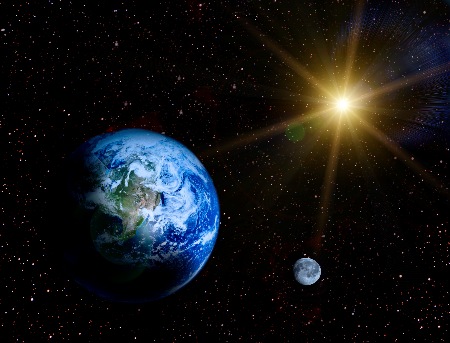
5 And the Lord said unto me: The planet which is the lesser light, lesser than that which is to rule the day, even the night, is above or greater than that upon which thou standest in point of reckoning, for it moveth in order more slow; this is in order because it standeth above the earth upon which thou standest, therefore the reckoning of its time is not so many as to its number of days, and of months, and of years.
(Abr. 3:5)
This “planet” is the Moon (the “lesser light” see Gen 1). The Sun and moon were classed as “stars” and as among the “seven stars” (Sun, Moon, and five visible planets). So it is not unusual for the text to refer to the Moon as a “planet”. It “moves in order more slow” (it’s day is thirty earth days) “because it standeth above the earth” (because it orbits the earth and tidally locked).
6 And the Lord said unto me: Now, Abraham, these two facts exist, behold thine eyes see it; it is given unto thee to know the times of reckoning, and the set time, yea, the set time of the earth upon which thou standest, and the set time of the greater light which is set to rule the day, and the set time of the lesser light which is set to rule the night.
7 Now the set time of the lesser light is a longer time as to its reckoning than the reckoning of the time of the earth upon which thou standest.
(Abr. 3:6-7)
set time (Hebrew Mo’ed). We read in Genesis:
14 And God said, Let there be lights in the firmament of the heaven to divide the day from the night; and let them be for signs, and for seasons, and for days, and years:
(Gen. 1:14)
The Hebrew word here for “seasons” is mo’edim, which could also be translated, as we see it here in the Book of Avraham, as “set times” or “appointed times”.
8 And where these two facts exist, there shall be another fact above them, that is, there shall be another planet whose reckoning of time shall be longer still;
9 And thus there shall be the reckoning of the time of one planet above another, until thou come nigh unto Kolob, which Kolob is after the reckoning of the Lord’s time; which Kolob is set nigh unto the throne of God, to govern all those planets which belong to the same border as that upon which thou standest.
10 And it is given unto thee to know the set time of all the stars that are set to give light, until thou come near unto the throne of God.
(Abr. 3:8-10)
See comments on Kolob to Avraham 3:1-4.
11 Thus I, Abraham, atalked with the Lord, face to face, as one man talketh with another; and he told me of the works which his hands had made;
12 And he said unto me: My son, my son (and his hand was stretched out), behold I will show you all these. And he put his hand upon mine eyes, and I saw those things which his hands had made, which were many; and they multiplied before mine eyes, and I could not see the end thereof.
13 And he said unto me: This is Shinehah, which is the sun. And he said unto me: Kokob, which is star. And he said unto me: Olea, which is the moon. And he said unto me: Kokaubeam, which signifies stars, or all the great lights, which were in the firmament of heaven.
(Abr. 3:11-13)
Shinehah Possibly related to Hebrew שנה shanah “year, the course of the sun” and Egyptian sheni “encircle”.
Kokob (כוכב) The Hebrew word for “star” but which, in Hebrew, refers to any heavenly body, such as the Sun, Moon and planets.
Olea Perhaps related to אורה Urah (light) (“l” and “r” are indistinguishable in Egyptian hieroglyphics, which has no “l” phoneme, and substitutes “r” for foreign words that contain the “l” phoneme.
Kokaubeam (כוכבים) The Hebrew plural for “star” (stars)
14 And it was in the night time when the Lord spake these words unto me: I will multiply thee, and thy seed after thee, like unto these; and if thou canst count the number of sands, so shall be the number of thy seeds.
Implicitly, in context, also like the stars of the sky (as is plainly stated in the parallels in Gen. 15:5; 22:17 and 26:4; Ex. 32:13; Deut. 1:10). In Joseph’s dream, he saw his father, mother and bothers as “the sun and the moon and the eleven stars” (Gen. 37:9) making a correspondence between the twelve tribes and the twelve constellations of the Zodiac.
15 And the Lord said unto me: Abraham, I show these things unto thee before ye go into Egypt, that ye may declare all these words.
(Abr. 3:15)
The First Century Jewish writer records the fact that Avraham did in fact teach astronomy to the Egyptians:
For whereas the Egyptians were formerly addicted to different customs, and despised one another’s sacred and accustomed rites, and were very angry one with another on that account, Abram conferred with each of them, and, confuting the reasonings they made use of, every one for their own practices, demonstrated that such reasonings were vain and void of truth: whereupon he was admired by them in those conferences as a very wise man, and one of great sagacity, when he discoursed on any subject he undertook; and this not only in understanding it, but in persuading other men also to assent to him. He communicated to them arithmetic, and delivered to them the science of astronomy; for before Abram came into Egypt they were unacquainted with those parts of learning; for that science came from the Chaldeans into Egypt, and from thence to the Greeks also.
(Josephus; Ant. of the Jews 1:8:2)
16 If two things exist, and there be one above the other, there shall be greater things above them; therefore Kolob is the greatest of all the Kokaubeam that thou hast seen, because it is nearest unto me.
17 Now, if there be two things, one above the other, and the moon be above the earth, then it may be that a planet or a star may exist above it; and there is nothing that the Lord thy God shall take in his heart to do but what he will do it.
18 Howbeit that he made the greater star; as, also, if there be two spirits, and one shall be more intelligent than the other, yet these two spirits, notwithstanding one is more intelligent than the other, have no beginning; they existed before, they shall have no end, they shall exist after, for they are gnolaum, or eternal.
(Abr 3:16-18)
gnolaum Hebrew עוֹלָם “Olam” meaning “world, age, eternal”. Smith transliterated the ע which is generally taken in Modern Hebrew as silent, with “gn”. Smith studied Hebrew under Joshua Seixas, author of A Manual Hebrew Grammar for Use of Beginners, which assigns the ע a pronunciation of “gn”.
19 And the Lord said unto me: These two facts do exist, that there are two spirits, one being more intelligent than the other; there shall be another more intelligent than they; I am the Lord thy God, I am more intelligent than they all.
20 The Lord thy God sent his angel to deliver thee from the hands of the priest of Elkenah.
21 I dwell in the midst of them all; I now, therefore, have come down unto thee to declare unto thee the works which my hands have made, wherein my wisdom excelleth them all, for I rule in the heavens above, and in the earth beneath, in all wisdom and prudence, over all the intelligences thine eyes have seen from the beginning; I came down in the beginning in the midst of all the intelligences thou hast seen.
(Abr. 3:19-21)
Here stars (astronomical bodies) are likened to angels just as in Revelation 12:4 angelic hosts are allegorically represented by “stars”.
22 Now the Lord had shown unto me, Abraham, the intelligences that were organized before the world was; and among all these there were many of the noble and great ones;
23 And God saw these souls that they were good, and he stood in the midst of them, and he said: These I will make my rulers; for he stood among those that were spirits, and he saw that they were good; and he said unto me: Abraham, thou art one of them; thou wast chosen before thou wast born.
(Abr. 3:22-23)
According to the Talmud “the souls which are yet to be born” await the time of their birth , in the seventh heaven known as “Aravot”
‘Aravot is that in which there are Right and Judgment and Righteousness, the treasures of life and the treasures of peace and the treasures of blessing, the souls of the righteous and the spirits and the souls which are yet to be born… The spirits and the souls which are yet to be born, for it is written: For the spirit that enwrappeth itself is from Me, and the souls which I have made. (Is. 57:16)
(b.Chag. 12b)
This storehouse of souls is called the “Guf” (or “Guph”). According to the Talmud the Son of David (a title of Messiah in his second coming) will not come until the Guf has run out of souls:
R. Assi stated: The Son of David will not come before all the souls in Guf will have been disposed of, since it is said, For the spirit that unwrappeth itself is from Me etc. (Is. 57:16)
(b.Yev. 62a; 63b)
R. Jose stated: The Son of David will not come before all the souls in Guf will have been disposed of, since it is said, For the spirit that enwrappeth itself is from Me, and the souls which I have made. (Is. 57:16)
(b.Nidah 13b)
any of the noble and great ones; And God saw these souls that they were good The Talmud quotes a tradition whereby Job said “Lord of the universe, You have created righteous men and You have created wicked men” (b.Baba Batra 16a) however elsewhere the Talmud teaches that it is not preordained whether a man will be righteous or wicked (b.Niddah 16b) This apparent conflict is reconciled in the Tanya (Likutei Amarim Chapter 14) that while a man may have been created a righteous man or wicked man, he still has the freedom to choose to go against this nature and choose to act righteously or wickedly.
24 And there stood one among them that was like unto God, and he said unto those who were with him: We will go down, for there is space there, and we will take of these materials, and we will make an earth whereon these may dwell;
(Abr. 3:24)
The Jewish understanding of the process of Creation begins with a process known as Tzimtzum (contraction). Before the beginning of Creation, their was only Eyn Sof (The Infinite One). Eyn Sof is a Hebrew phrase that literally means “without end” or “without a border”. Since the Infinite One was all of everything, there was nothing that was not Eyn Sof. The first act of creation, therefore, was for Eyn Sof to contract upon Eyn Sof so as to create, for the first time, an empty space, and area that was not Eyn Sof for a universe, thus allowing foe, not only a universe, but for freewill. It was in this empty space, that our universe would be created.
we will take of these materials – The First Century Jewish Writer Philo of Alexandria taught that the Universe was transformed from Pr-Existent material into this world. He wrote:
(8) But Moses, who had early reached the very summits of philosophy, {1}{this is in accordance with the description of him in the Bible, where he is represented as being learned in all the wisdom of the Egyptians.} and who had learnt from the oracles of God the most numerous and important of the principles of nature, was well aware that it is indispensable that in all existing things there must be an active cause, and a passive subject; and that the active cause is the intellect of the universe, thoroughly unadulterated and thoroughly unmixed, superior to virtue and superior to science, superior even to abstract good or abstract beauty; (9) while the passive subject is something inanimate and incapable of motion by any intrinsic power of its own, but having been set in motion, and fashioned, and endowed with life by the intellect, became transformed into that most perfect work, this world.
(Philo on Creation 8-9)
(22) For the substance was of itself destitute of arrangement, of quality, of animation, of distinctive character, and full of all disorder and confusion; and it received a change and transformation to what is opposite to this condition, and most excellent, being invested with order, quality, animation, resemblance, identity, arrangement, harmony, and everything which belongs to the more excellent idea.
(Philo on Creation 22)
(See comments to “organized” in Abraham 4:1)
25 And we will prove them herewith, to see if they will do all things whatsoever the Lord their God shall command them;
26 And they who keep their first estate shall be added upon; and they who keep not their first estate shall not have glory in the same kingdom with those who keep their first estate; and they who keep their second estate shall have glory added upon their heads for ever and ever.
27 And the Lord said: Whom shall I send? And one answered like unto the Son of Man: Here am I, send me. And another answered and said: Here am I, send me. And the Lord said: I will send the first.
28 And the second was angry, and kept not his first estate; and, at that day, many followed after him.
(Abr. 3:25-28)
See Gen. 3:1 (JST Gen. 3:1-6 = Moses 4:1-5)
Return to Sefer Avraham Commentary
This research and this page are made possible by donations from our readers. Please consider supporting this work with a donation.
 Restoration Torah Research