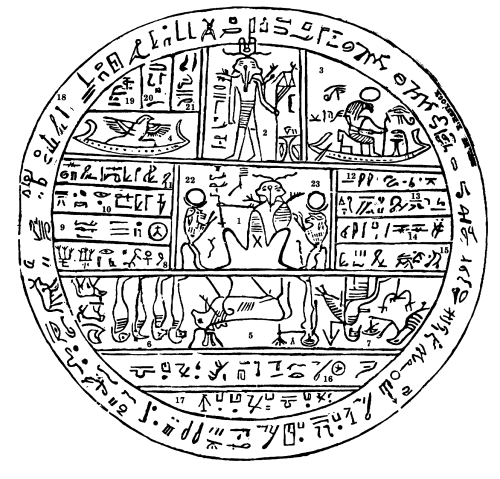
5. Is called in Egyptian Enish-go-on-dosh; this is one of the governing planets also, and is said by the Egyptians to be the Sun, and to borrow its light from Kolob through the medium of Kae-e-vanrash, which is the grand Key, or, in other words, the governing power, which governs fifteen other fixed planets or stars, as also Floeese or the Moon, the Earth and the Sun in their annual revolutions. This planet receives its power through the medium of Kli-flos-is-es, or Hah-ko-kau-beam, the stars represented by numbers 22 and 23, receiving light from the revolutions of Kolob.(Book of Abraham Facsimile 2 Figure 5)
Here the explanation to Facsimile 5 says that the Sun “borrows its light from Kolob” while Philo says the Sun derives its light from the Logos. It seems very likely that Philo was familiar with the Book of Abraham. (This is not a surprise, since Philo was a Jew who lived in first Century Egypt, and the Joseph Smith Papyri and mummies date to the Ptolemaic period of Egypt, from sometime between 300 and 100 BC).
If we interpret Kolob in the Book of Abraham in light of this corresponding statement in Philo’s On Creation, in context of the prior material in Philo’s On Creation, Kolob is not only identifiable with the Logos (“The Word”; “The Divine Reason”) but was the blueprint for the Sun, Moon and stars. Kolob, then, does not exist in the temporal world perceptible to the external senses, but only exists in the world perceptible only to the intellect. Kolob is the original idea of a star in the mind of Elohim, it is the blueprint for all the heavenly bodies in our universe.
Philo writes:
(30) And air and light he considered worthy of the pre-eminence. For the one he called the breath of God, because it is air, which is the most life-giving of things, and of life the causer is God; and the other he called light, because it is surpassingly beautiful: for that which is perceptible only by intellect is as far more brilliant and splendid than that which is seen, as I conceive, the sun is than darkness, or day than night, or the intellect than any other of the outward senses by which men judge (inasmuch as it is the guide of the entire soul), or the eyes than any other part of the body. (31) And the invisible divine reason, perceptible only by intellect, he calls the image of God. And the image of this image is that light, perceptible only by the intellect, which is the image of the divine reason [Logos], which has explained its generation. And it is a star above the heavens, the source of those stars which are perceptible by the external senses, and if any one were to call it universal light he would not be very wrong; since it is from that the sun and the moon, and all the other planets and fixed stars derive their due light, in proportion as each has power given to it; that unmingled and pure light being obscured when it begins to change, according to the change from that which is perceptible only by the intellect, to that which is perceptible by the external senses; for none of those things which are perceptible to the external senses is pure.(Philo; On Creation 30-31)
The Greek word Philo uses for “divine reason” is “Logos” which is the “Word” (as in the Greek text of John 1:1-3)
Under Construction
Return to Sefer Avraham Commentary
This research and this page are made possible by donations from our readers. Please consider supporting this work with a donation.
 Restoration Torah Research